

Until alternator chargers became available, portable power stations struggled to get enough power to recharge their batteries when mains power wasn’t available. As our desire for gadgets grows while remote, so does our power needs increase.
Two years ago, I struggled to keep my Bluetti AC200Max power station recharged using a cigarette lighter plug and a solar panel. Mains charging was few and far between. Installing a Bluetti Charger 1 was a game-changer, allowing me to charge at much higher wattage directly from my car’s alternator. Now the Bluetti Charger 2 is available, and on paper, it appears to be another revolution.
Table of contents
- Why is an alternator charger a good idea?
- Bluetti Charger 2 features
- Specifications and price
- Using the Bluetti Charger 2
- Who is the Bluetti Charger 2 for?
Why is an alternator charger a good idea?
I have just upgraded my car’s power station from 2,000Wh to 3,000Wh, which is a fair amount of power to recharge when you do not have access to a power point. If I did have a mains power outlet, the Bluetti Elite 300 could charge at 2,300 watts. Assuming your model power station accepts this wattage charge, after one hour, with no losses (which you would have), that would recharge 2,300Wh.
In a remote situation, a car cigarette lighter plug can provide approximately 120W, so after 20 hours of driving, you would reach the same 2,300W. A 200W solar panel is dependent on a sunny, clear sky. In practice, you will get about 1000Wh per day (more in summer, less in winter).
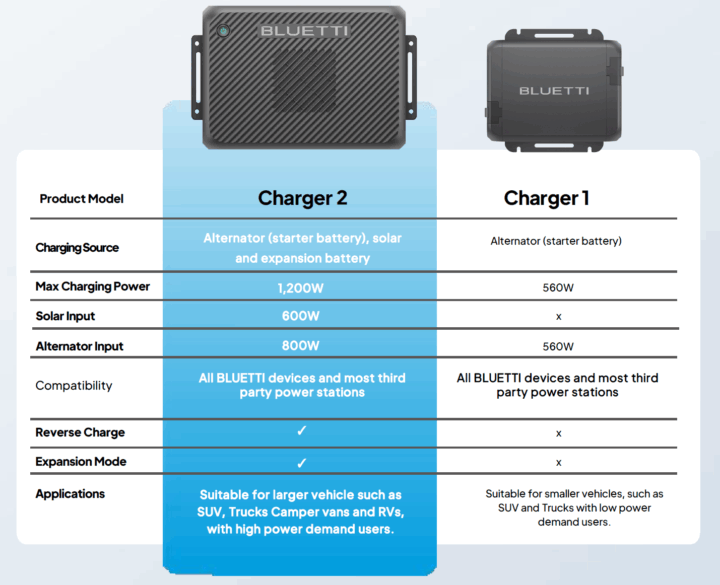
An alternator charger takes the 12-volt power from a car’s alternator, changes that, and steps it up to 56 volts at 10 amps, for a total of 560W (Charger 2 up to 800W). After just over four hours of driving, you will generate the same amount of energy, 2,300Wh. That is a big saving from 20 hours down to four hours of driving.
Bluetti Charger 2 features
The Bluetti Charger 2 can charge a portable power station simultaneously from a vehicle’s alternator and solar panels if available. This means you maximise power input whether you are driving or not.
The Charger 2 can also operate independently as a 12-volt power system. If you add a Charger 2, a battery, and a 12-volt output, you could power a 12-volt fridge without buying a power station. From the same battery (not the power station), or from a solar panel producing power, you can send a charge back to your car’s starter battery (known as reverse charging), topping up its charge or potentially starting the engine if the starter battery is flat.
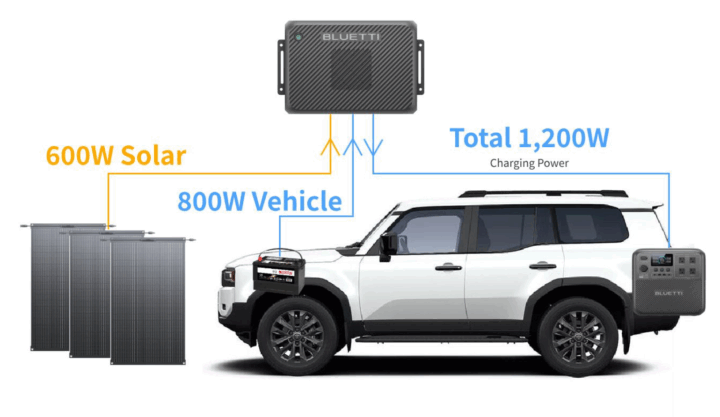
The Charger 2 can supply up to 800W from your alternator if your alternator has that excess capacity, and your power station must be capable of accepting that much DC wattage. Most cars would not have enough roof space for it, but if you had a truck, for example, you could install up to 600W of solar power. The charger has a max output of 1,200W. Solar is prioritised over alternator power, so assuming you did have the maximums, it would use 600W from solar but only 600W from the alternator.
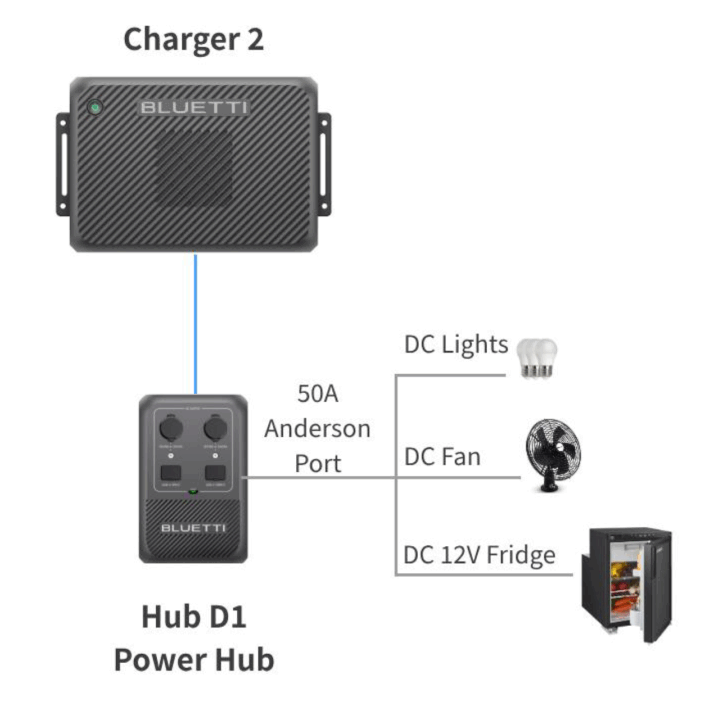
At the time of writing, the Charger 2 costs $599 via Bluetti’s website (down from its $999 RRP). If you just want a reliable 12-volt solution, the brand sells a $2,799 bundle (normally just over $4,000) that includes an expansion battery with 2,764.8Wh, a Charger 2, and a DC hub, which is everything you need to set up a DIY 230Ah-equivalent battery solution. The DC hub provides 12V via a cigarette socket or a 50A Anderson plug, as well as USB with a total limit of 600W.
To create a 12-volt/240-volt solution, there is a bundle for $2,999 ($4,498 once the pre-order pricing ends) that includes an Elite 300 and a Charger 2. This is a better solution in my mind, as you get a bigger 3,000Wh battery and 240 volts for $200 more.
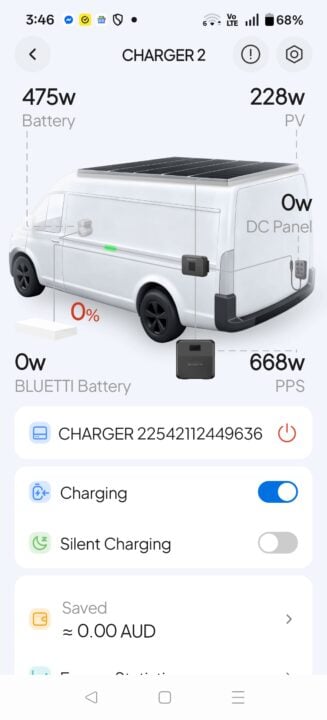
In the Bluetti app, you can track how much power is coming from where and how much is going out. You can connect via Wi-Fi or Bluetooth, but unless you have a mobile router in your car, I suggest setting the default connection to Bluetooth.
Bluetti Charger 2 specifications and price
| Power | 800W at 56 volts |
| Operating temperature | -20 to 60 degrees Celsius (power degraded above 40 Deg) |
| Noise | 50dB |
| Dimensions | 27 x 17 x 7 cm 1.6kg |
| Price (RRP) | $999 (discounted launch price is $599) |
| Website | Bluetti Australia |
| Warranty | 2 years |
Using the Bluetti Charger 2
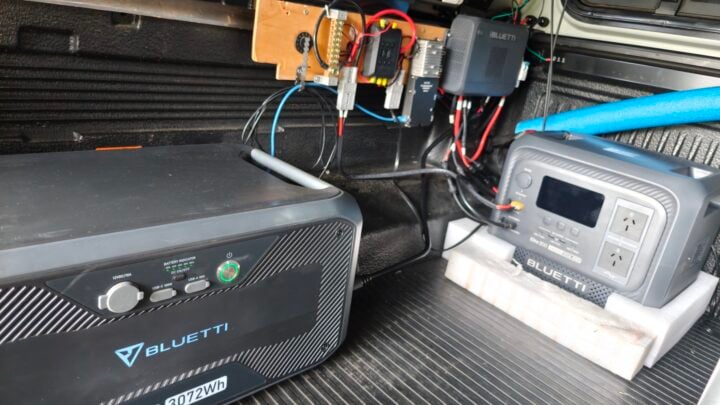
I upgraded from a Charger 1, so I did not need to run the supplied 5-metre cable from the engine bay to my ute canopy. So, I simply unscrewed the Charger 1, replaced it with the Charger 2, and connected the existing cable.
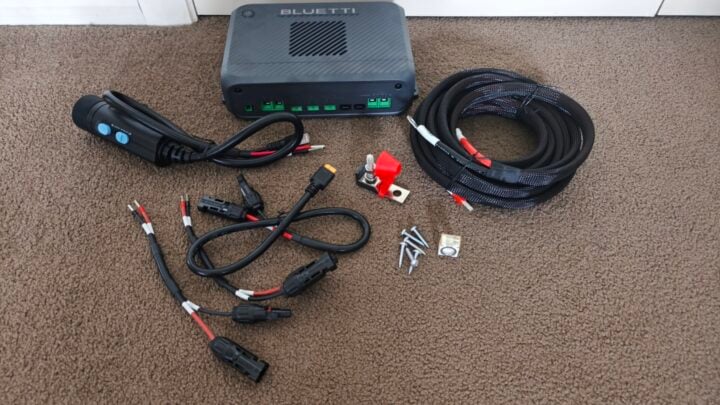
I fell into the trap of mistaking the two MC4 cables as the same. Turns out there is a small label that says “PV” on one and “charger” on the other. I had these the wrong way round, and until I rectified this, my solar charging did not work. This is a DIY job with just a screwdriver, a spanner and a few cable ties, but seek a professional’s help if you are not confident.
If using a Bluetti power station in the setup, select your power station model in the app, and the app will set the correct charging voltages for that model. If you are using a competitor’s power station, connect Charger 2 to the power station’s solar input and set the voltage to the maximum PV (solar) voltage, as per your power station’s specifications. Charger 2 charging can be turned off via the app.
If you are connecting an extension battery, plug it into the Charger 2 using the supplied cord. If you want power from the Charger, you need the DC power hub ($499 RRP) or a package. In my case, I have a B300 expansion battery, which has 3kWh of power.
When connected to the Charger 2, and a power station is also connected, the power station will charge. This can only be stopped by disconnecting it. If I were planning to use a lot of power, such as powering my caravan and its air conditioning from my car, this would be a good solution.
A feature I have noted is that once you turn the car off and there is no solar, the Charger 2 will go into standby mode and stop charging. However, the unit does stay in standby mode, still drawing power and allowing app access. Bluetti tells me this power draw is less than 1W, and the unit will eventually power down, so there is no power draw, and it will not drain your battery during long periods of inactivity.
A feature I would like to see added in a software update is the ability to disable alternator charging while keeping solar charging enabled. Today, it is all on or all off via a switch in the app. I charge my caravan power system and now my Bluetti power station via my car’s alternator. This puts a lot of strain on my vehicle’s power system, and I would like to reduce it by disabling alternator charging. I currently have a physical power switch on the cable from the car battery to the Charger 2, which achieves this, but it would be good to be able to do this from the passenger seat whilst driving.
Many people buy petrol generators to meet off-grid needs. If you are in camp with a portable power station and run low on power, you can always run your car for an hour to recharge, which will be much cheaper than buying a heavy, smelly petrol generator as a backup.
Who is the Bluetti Charger 2 for?
A Bluetti alternator charger makes so much sense if you’re travelling and need power beyond what a battery will hold. Its fast charging means you will have power when you need it, so you don’t have to worry about running out.
You would buy the Bluetti Charger 2 over the Charger 1 if you spend long periods camping and not moving. This way, when combined with solar, you have power coming in, and any drives you do will maximise your charging. Although the plug-and-play 12-volt solution makes sense over a fixed 12-volt installation in a vehicle, I believe the best solution is to pair the Charger 2 with almost any brand of power station.
Once you set it up, the Charger 2 is pretty much set and forget, knowing you have a fast, reliable source of power to recharge your devices.