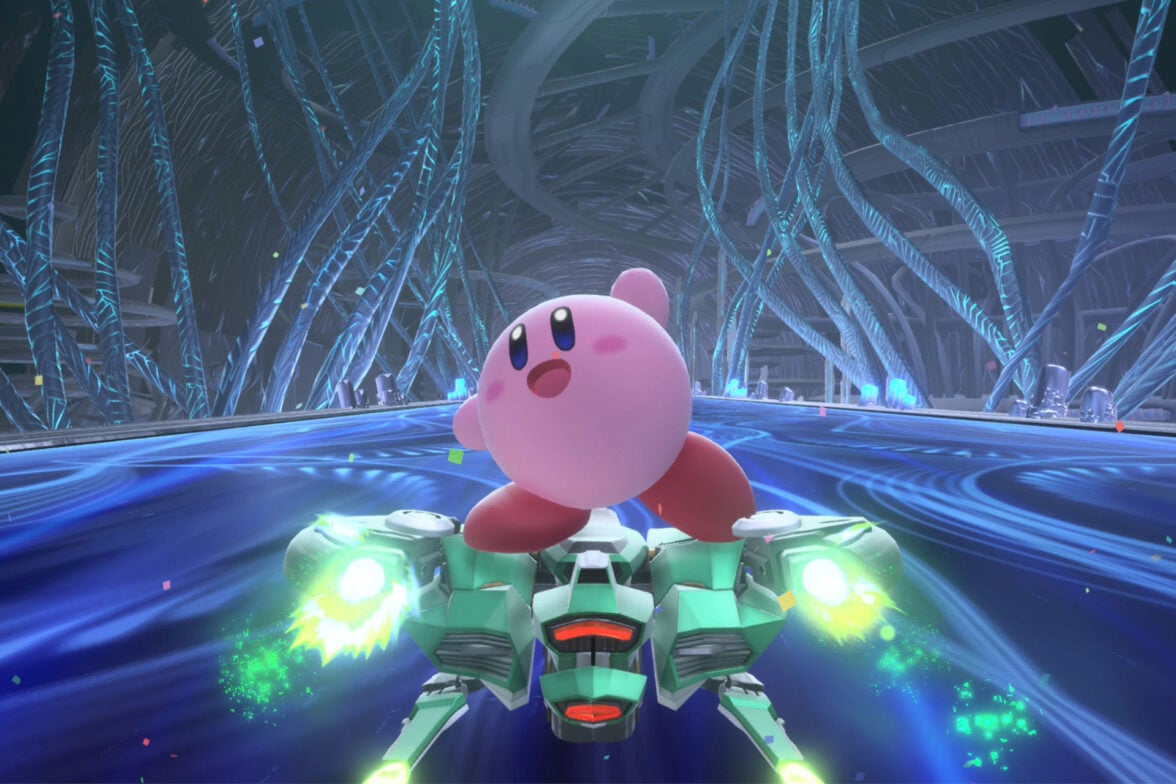

I was ready to dismiss Kirby Air Riders before I played it. Figurative Maxim Tomatoes in hand, I thought releasing a competing racer based on a niche spin-off just months after Mario Kart World was ill-advised. Good thing I’m not involved in Nintendo’s decision-making, because to label Kirby Air Riders as just another arcade racing game would be disastrously reductive.
While the GameCube’s Kirby Air Ride lost my interest within hours, I’m still enamoured with Kirby Air Riders (emphasis on the ‘rs’). It’s faster, more complex, and as engaging for solo players as it is for communal mayhem.
That such a relatively simple racer is so deceptively deep is remarkable. Vehicles accelerate automatically, leaving only two buttons and a control stick required for every other action. Said simplicity leaves plenty of room for skill and variety to shine, most of which is found when experimenting with Air Riders’ cleverly designed vehicles.
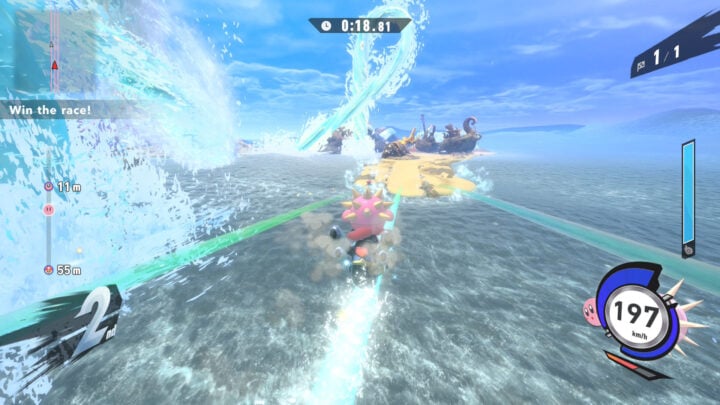
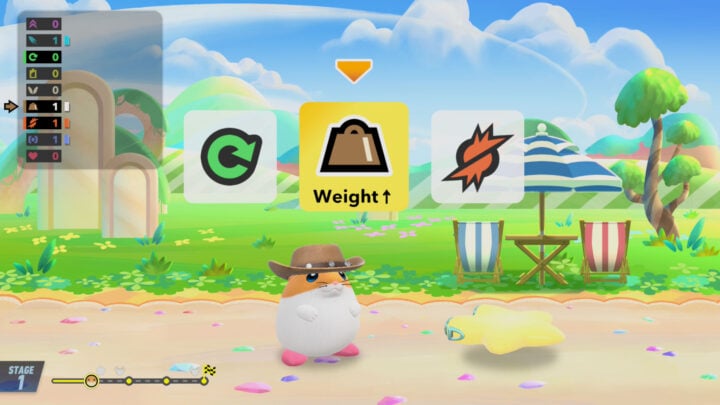
Road Trip, the new single-player mode, is an excellent centrepiece for solo racers that Air Riders’ predecessor sorely lacked. It brings together several disparate modes and mini-games with a charmingly earnest story justifying the existence of Kirby’s racing machines.
On the other side is City Trial, a returning mode from the GameCube original. The frenetically fast-paced free-for-all has its moments, but quickly devolves into a kaleidoscopic cacophony of Kirby chaos that’s often tricky to follow.
But Kirby Air Riders surprisingly has more depth than the pink protagonist’s appetite for food. It rewards curiosity and experimentation, revealing more of its nuances the more you play.
Kirbus ex machina
Variety is what sets Kirby Air Riders apart from a crowded garage of colourful racing games. As much as its myriad game modes sustain novelty over time, the diversity of vehicles puts in the most work.
For many racing games, different vehicles or car components result in subtle yet meaningful tweaks to how they handle. This well-established convention typically operates on a sliding scale: heavy vehicles, for example, often hit higher top speeds, at the expense of acceleration and manoeuvrability, while the opposite applies for nimbler rides.
Kirby Air Riders inhales these conventions and spits out a refreshingly new approach. Each vehicle — many of which are unlocked by completing in-game challenges — tangibly changes the way the game plays.
Some vehicles can’t glide, forcing you to approach tracks differently than when piloting an airborne specialist. One of the game’s fastest rides stops immediately the moment you hit the brakes, able to turn at right angles, but is otherwise incredibly unwieldy to steer.
It’d be easy to stick with Kirby’s famous Warp Star, a vehicle good at most things without excelling at any of them. But Air Riders thrives on pushing the boundaries of normalcy.
This variety doesn’t just exist for novelty’s sake, though. Each vehicle and its accompanying riders have clear strengths suited to Air Riders’ different modes. Some are beefy tank-like brawlers suited to taking out other riders. Others zoom faster through the air than on the ground. Discovering which vehicles suit your playstyle and each mode is a big part of the fun.
Variety is the spice of life
As surprising as it may sound, I question whether the variety goes far enough. Lush and gorgeous as Air Riders’ tracks may be, most reach their conclusion all too soon. A minute or two is usually all it takes to reach the finish line, not long enough for races to establish a rhythm and a compelling push-pull dynamic between competitors. Returning tracks from the original GameCube game are the guiltiest of this, but the newer courses provide more interesting layouts.
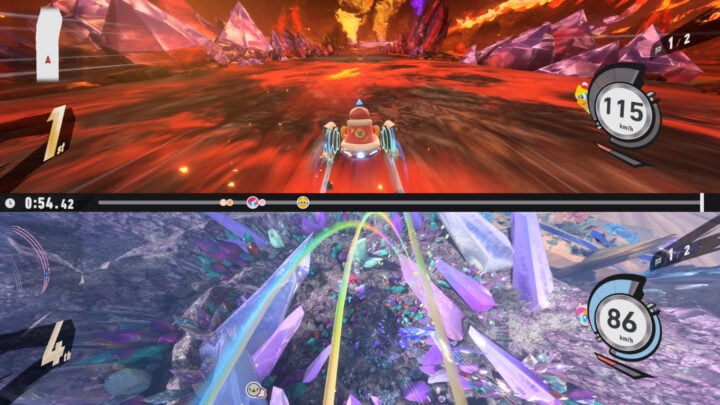
Kirby Air Riders makes up for the relative breeziness of its individual parts through sheer quantity. There’s so much to do and unlock, supplying ample incentive to sample everything from Kirby’s racing buffet.
Every game mode has its own set of unlockables, spanning new characters, vehicles, tracks, and cosmetics to give rides a snazzy makeover. Upon starting the game, the unlocks flow freely, like hitting the jackpot in a slot machine. In these early hours, you’re rewarded so often, it feels like scratching your arse would be enough to score a new unlock.
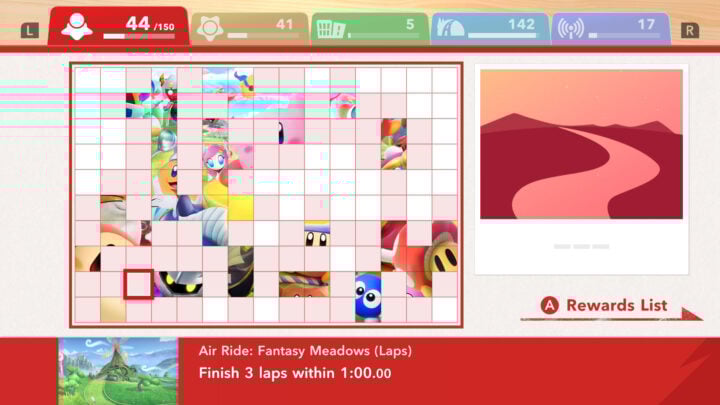
Eventually, the reward rate settles down, which works in Kirby Air Riders’ favour. Instead of giving you all the toys to play with from the beginning, it encourages you to try each mode, hone your skills in time attack or combat trials, and experiment with different rider and vehicle combinations.
Kirby Air Riders: Verdict
What looks like an unassuming kart racer on the surface belies the true nature of Kirby Air Riders. It may look cute and fuzzy on the surface, but here is an approachable racing game with a surprising amount of nuance and depth.
Uneven at times, with some modes and tracks stronger than others, Kirby Air Riders is still a significant improvement over the GameCube cult classic. Consider me converted.
Nintendo provided a Nintendo Switch 2 code of Kirby Air Riders for review coverage.