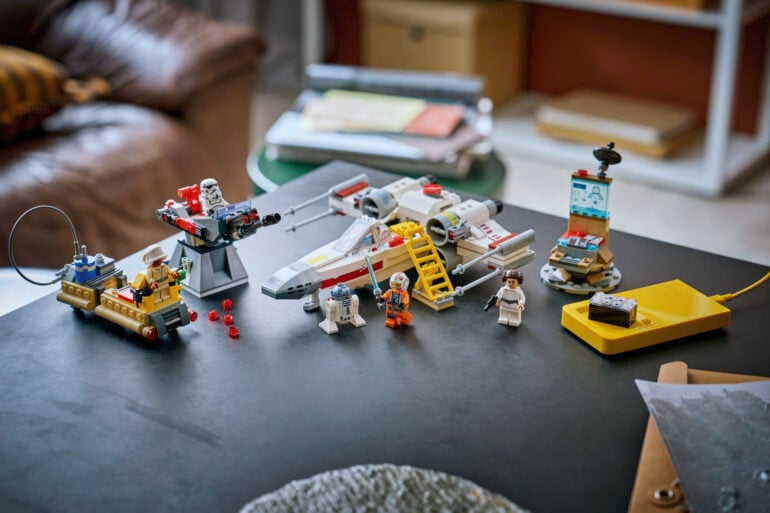

Last week at CES, Lego announced the new Smart Play system, which includes Smart Bricks, Smart Tags and Smart Minifigures. The Smart Play system is what spokespeople are claiming is the biggest change to the Lego system since the advent of the minifigure.
That’s a huge call, because the minifigure was released in 1978, and so much has happened since then. Technic was revamped and renamed in 1984, with the ability to construct automatic structures introduced in 1986, and Mindstorms was introduced in 1998.
So, when I sat down with Tom Donaldson, Senior Vice President & Head of Creative Play Lab at the Lego Group, I had to ask how they came to that conclusion.
“I think we just see it as very similar to the minifigure,” Donaldson said. “If you imagine the world before the minifigure, with bricks you could build tonnes of great models.”
“You can still have great models without the minifigure, but it adds a layer of play, and that layer has gone through not our entire portfolio, but a very significant proportion of our portfolio, bringing roleplay, characters and worlds alive.”

Lego see the Smart Play system being applied across almost every Lego theme in the range for the foreseeable future, with plans for longevity. Whereas the Mario Interactive figures were limited to just Mario sets, and although the Smart Play system is launching in Lego Star Wars first, the company hopes for broad adoption.
“We set out at the start to do something that we thought would be something that would last a while and have a lot of potential,” Donaldson said. “So, we’re certainly very hopeful, but ultimately, as a company, I think one of our strengths is to be really focused on what the kids want and follow that.”
The long Lego Smart Play journey
The project started eight years ago when the first concepts were introduced. But the real, deep technical work only started six years ago.
The biggest problem for Lego in the beginning was attempting to make an extremely advanced piece of technology, unlike anything that had been made before, as a non-technology company that dealt primarily with plastic.
In the Smart Brick are a variety of sensors, including light, sound and an accelerometer, and it has an onboard synthesiser, so no sound effects are pre-recorded. It doesn’t connect to your phone, there’s no app, there’s no screen: it’s just basic technology, engineered in a complicated way, designed to be simple to use. You might see a light or sound brick in some sets. This is taking that to a new level and then putting that concept on steroids.
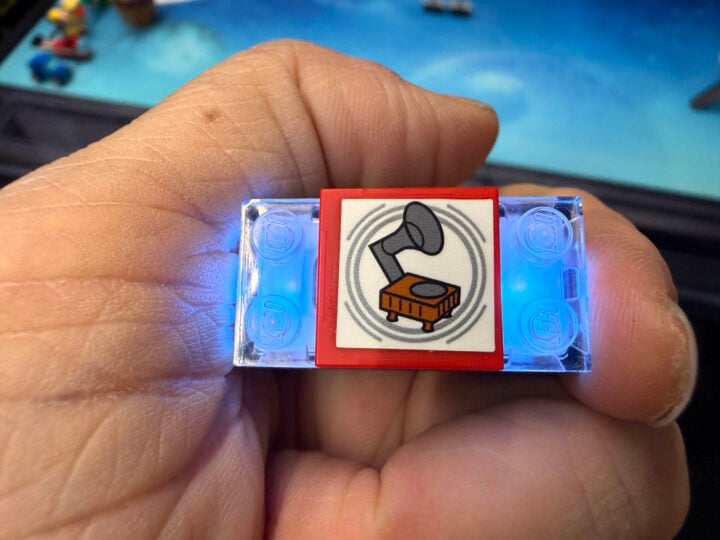
“Right from the start, we wanted the sets to understand and talk to each other,” Donaldson said. “I don’t think there’s any sensor technology that would allow the bricks to know where they were so that we could have cars race each other and all of those sorts of things, without some sort of a beacon or centralised node, other than our [Smart Bricks].”
“We couldn’t have found that anywhere off the shelf.”
The other problem was making the bricks. “At the scale that we’re building, the manufacturing has such tight tolerances that just getting a production line that can produce them at a high quality consistently has been an amazing challenge,” Donaldson explained.
One unusual feature of the Smart Brick device is that it has no power button, no reset button, and no way to turn it on or off other than shaking it to wake it. That’s great for kids who are never going to remember to turn it off when they’re done (and also some adults), but everyone who has ever had to do tech support can see the challenge in that.
“It’s very rare to build a system that you can’t turn off and on again to fix it,” Donaldson said. “We can’t do that, and it’s a serious technical challenge.”
“There are a couple of secret mechanisms that we can trigger together with the charger to drive a reset. There’s a particular way of orienting it on the charger that, in desperate times, causes a reset. But it’s a very specific system.”
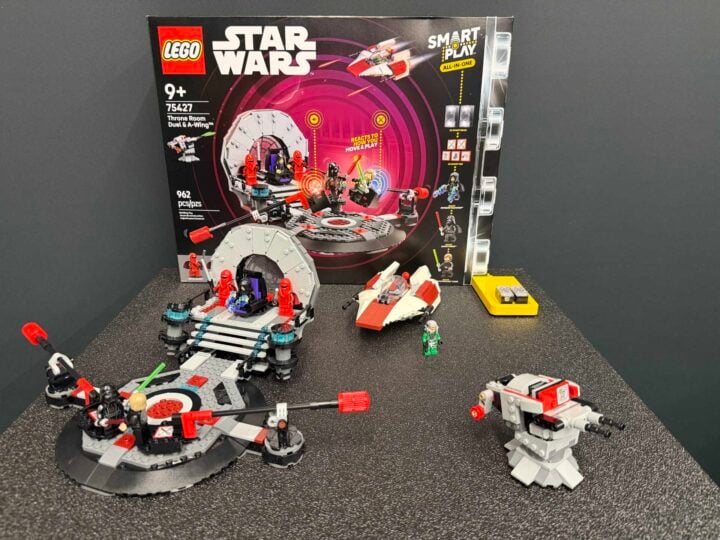
It appears to be inspired by kids who run around their bedroom making whooshing sounds while flying a brick-built aeroplane, in the best way. This is the toy for anyone who ever chased their sibling around the house with a model toy, making vroom vroom noises, or who made sounds while slashing their toy lightsaber.
That meant that the brick had to have good sound coming out of the on-board synthesiser. That’s a challenge on devices the size of lunchboxes; it’s an even bigger challenge on something the size of a Lego brick. While it’s tinny, and wouldn’t be out of place on a chiptune soundboard, I can only assume Lego had an entire department dedicated to making bargains and doing dark magic to pull that off.
Focusing on AI could’ve made “a worse product”
While it felt like every device on the CES show floor had some kind of generative AI feature, it’s refreshing to see that the Lego Smart Play System is deliberately closed off from that. Though, generative AI is still something Lego is exploring.
“Right from the start, we imagined at some point AI might be relevant, but at the minute I think we have an incredibly compelling proposition without AI,” Donaldson said. “The important thing is the physical object that we have is great to play with.”
“I think that if we spent the time developing AI rather than the great physical play, I suspect at this point in the process we’d have a worse product.”
When working with kids, they’re generally the most opinionated people on the planet, and they will tell you straight what’s wrong with anything. So, the testing phases were full of unexpected turns for Donaldson and the team.
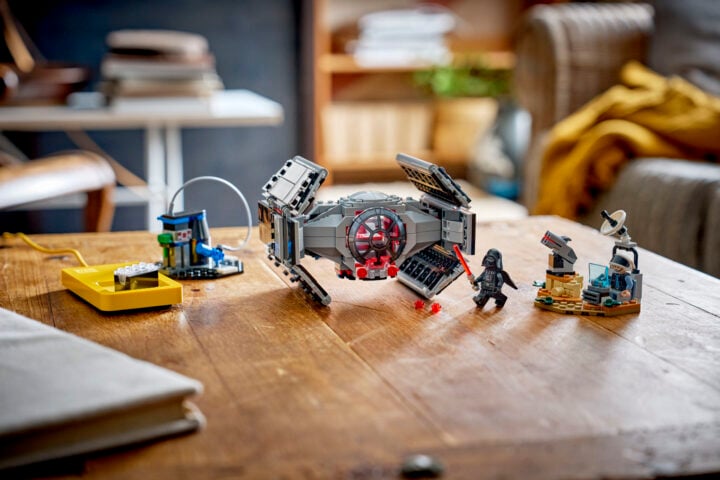
“I think the most surprising thing has actually been that the vision we started with has stayed reasonably true,” he said. “I’m very used to products, where the first time you show them to kids, you’re completely wrong, and you have to think again.”
“It’s been quite nice how often our first hypothesis has been proven to be not too far off the mark.”
Having now seen kids play with the brick (and also played with it myself), I think they definitely hit a bullseye.
The first wave of Star Wars Smart Play sets will hit stores on March 1, with pre-orders open now. Stay tuned for our thoughts on the new sets soon.
Alice travelled to CES as a guest of Lego and Intel.