
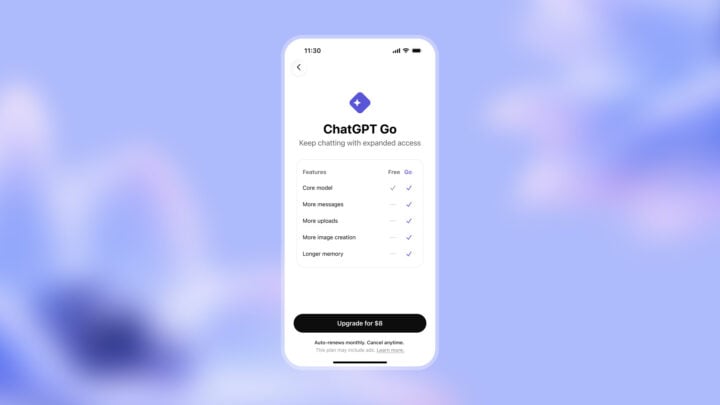
OpenAI announced ‘ChatGPT Go’ over the weekend, a lower-cost subscription sandwiched between its ‘Plus’ and free tiers. But the bigger news was OpenAI publicly discussing how it will integrate ads into its popular chatbot.
Priced at $13 per month in Australia, ChatGPT Go is OpenAI’s new entry-level subscription tier, sitting below the $30 monthly Plus tier and the $300 monthly Pro plan. It provides users with “10x more” messages, file uploads, and image generation on the latest GPT-5.2 model than ChatGPT’s free plan.
Based on OpenAI’s stated intentions, ChatGPT Go, in addition to its free plan, will be accompanied by advertising, starting with a test phase overseas.
According to OpenAI, “ads will be clearly labelled and separated from the organic answer.” Similarly, it claims that advertising does not influence ChatGPT’s responses to users. OpenAI also promised to “never sell” users’ data to advertisers and that conversations with its chatbot remain private.
How will ads display in ChatGPT?
Ads won’t appear to all users right off the bat. OpenAI plans to test advertising in ChatGPT responses “in the coming weeks” for free and Go users in the US. There’s no public timeline on how long the test period will last, or when Australian users will start seeing ads.
As part of the testing period, ChatGPT will not display ads to users under the age of 18. Additionally, chatbot responses about topics including health, mental health, and politics will also prevent ads from displaying.
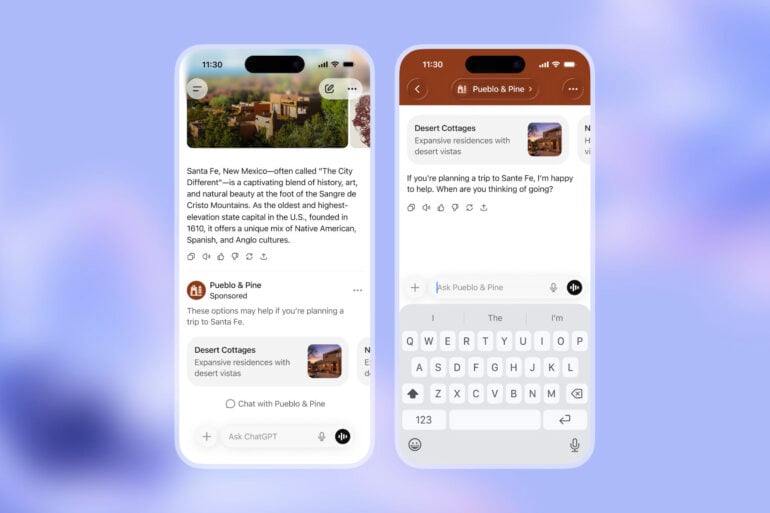
Here’s an example provided by OpenAI of what advertising could look like in ChatGPT:

Displayed at the bottom of a ChatGPT response, the ads will include a disclosure label, separating them from the chatbot’s answer. OpenAI appears open to the format of ads, including links to products, or “conversational interfaces” that users can interact with.
Why is OpenAI including ads?
Advertising is widely seen as OpenAI’s next step to help recoup its notably large expenditure, totalling billions of dollars over multiple years. Recently cited figures reach as high as US$150 billion between 2025 and 2030. That money is going towards data centres, partnerships with other companies, and other infrastructure costs associated with generative AI technology.
However, OpenAI is reportedly yet to start breaking even. It recently claimed US$20 billion in annual recurring revenue, but some experts believe OpenAI will run out of money before it can make good on its lofty promises.
Adding another variable into the mix is the fact that OpenAI is still a non-profit organisation. That’s expected to change in 2026, with discussions heating up over a potential public listing this year.
Put simply, generative AI technology is expensive. It requires a lot of computing power, largely supplied by server farms in big data centres. Not only are the components costly, but the associated high energy demands also add another layer of expenses.
OpenAI’s data points to more than 700 million weekly active users, but it’s estimated that most stick with ChatGPT’s free plan. As of November 2025, reportedly 35 million users subscribe to a paid plan, while OpenAI recently commemorated one million business customers.
So, with most people choosing not to pay for OpenAI’s chatbot, advertising is viewed as a potential revenue raiser. Only the future knows whether it will be enough to meet the organisation’s increasingly rising expenses.