
 ASUS
ASUSAI PCs: you’ve likely heard of the new generation of computers that have been making waves in recent years. Get ready to hear more about them because they’re only just getting started. Especially if ASUS has anything to do with it.
Even just a few short years ago, interacting with a computer meant understanding its language and adapting to a set of rigid commands. Now, with AI, PCs adapt to you, capable of responding to natural language, answering questions plainly, and automating work that previously required more of your time.
Billed as a smarter, stronger, and more efficient class of computer, AI PCs are designed to act as a companion that streamlines everyday work. Then you have Copilot+ PCs, the top-of-the-line devices that employ the best hardware and most efficient neural processing units (NPUs) that can handle even more on-device AI tasks.
Market research from Gartner claims that more than half of the PCs in the world will be AI PCs, such is the technology’s rise. Equipped with the latest chipsets from Intel, AMD, and Qualcomm, this modern era of computing takes on a wider variety of tasks than ever before.
Although AI PCs are only a relatively new concept, Bradley Howe, ASUS Australia’s Head of Consumer, believes the change they’ve sparked is substantial.
“If you were using a device from five years ago to today and how much it’s evolved in those five years is pretty significant,” Howe said. “And AI is a big part of how that evolution has happened.”
Explaining the AI PC phenomenon
At its heart, an AI PC is any PC that uses a dedicated NPU to power through AI-based tasks. Generally speaking, they chew through less battery by assigning background processes to the NPU, like noise cancellation and blurring your background during video calls.
Then the next step up are Copilot+ PCs, computers that meet higher performance benchmarks. This is where you benefit from more on-device AI functionality; large document summaries, image generation, and real-time captions or translations are hallmarks of the category.
But as much as the flashy AI features help users out in the day-to-day, Howe mentioned that a lot of the benefits of an AI PC fly under the radar.

“There’d be a lot of people that don’t even realise they’re actually utilising some form of AI functionality when they are probably in their daily lives, whether it be on a PC or even on their phone as well,” he said.
“And the great thing is, it’s actually just a really cool way to improve what you’re doing in terms of your daily tasks.”
Howe likens using AI PCs to having a “companion to work with”, able to answer questions, provide real-time information about what you’re working on, and as something to bounce ideas around with when needed. Even if it’s for something as small as tone-checking an email so you don’t sound too harsh.
The ASUS AI PC difference
There are a lot of AI PCs available now. Even within the Copilot+ PC category, the competition between PC brands is fierce. To stand out, ASUS leans heavily on making high-quality hardware that meets users’ needs.
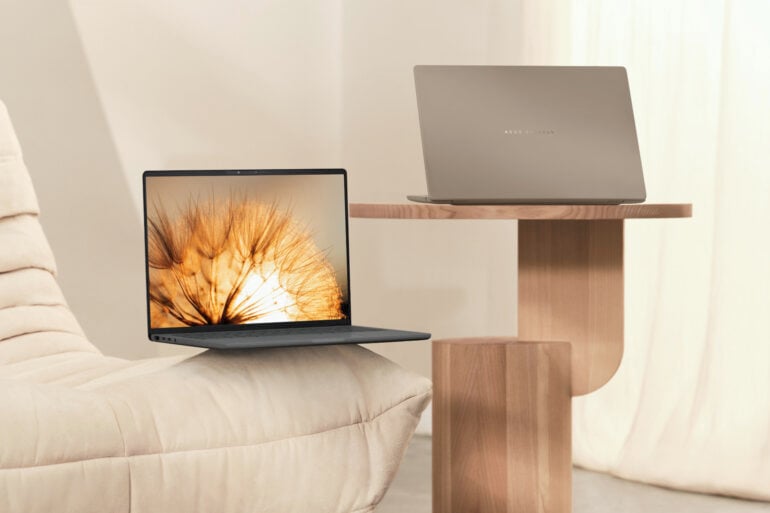
Howe turns to the Zenbook A14 OLED as a prime example of the brand’s AI PC approach. It’s stylish, sporting the tough and lightweight Ceraluminum hybrid material, but is practical, too.
“We’ve always been about innovation,” Howe said. “We spend a lot of effort making sure that our devices stand out on shelves.”

Perhaps an unheralded benefit of the AI PC boom is the significant leap in battery life on Windows PCs. These devices don’t require you to anxiously eye off nearby power outlets in case the dreaded low battery indicator pops up.
Thanks to its Snapdragon X series processors, the Zenbook A14 lasts up to 32 hours on a single charge. That’s based on continuous local 1080p video playback, a common measure used by computer manufacturers around the world. No matter which way you look at it, 32 hours is massive.
You’d think with that sort of battery life, you’d have to sacrifice portability, right? Not a chance. The Zenbook A14 weighs just 980g, making it easy to carry in any situation.
Building better AI features together
AI is not the result of any one person or company working in a silo. It’s grown in scale as a result of teamwork between many people, which is also the case for ASUS. Aside from using Microsoft’s AI technology included as part of the Copilot+ PC suite, ASUS has its own tools aimed at benefitting users.
One is StoryCube, an asset management hub that uses AI to intelligently organise media files. ASUS also recently teamed up with GoPro to streamline sorting through footage and photos, saving users time and effort in the process.
Instead of sorting media files manually — a time-consuming process — StoryCube can automatically categorise clips and pictures based on their content. Then similar clips can be grouped together for more efficient editing or sharing on social media.
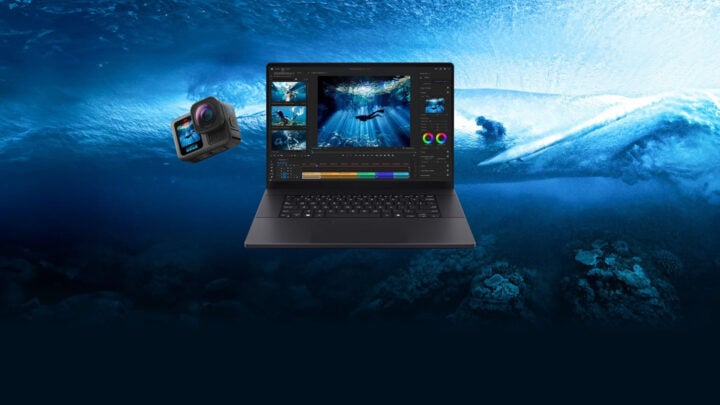
Text-based search is also a big benefit of StoryCube, and AI more broadly. Searching for files including ‘surfing’ sure beats struggling to remember which date you shot a video while riding a big wave.
Howe is quick to praise the “over 5,000 engineers” working for ASUS who are responsible for the company’s early efforts in the AI PC race. They work on not only the hardware, but also the software, like StoryCube, that streamlines the user experience.
That’s ultimately what ASUS is trying to achieve with its AI PCs now and into the future. It wants to make computers easier to use, while capable of doing more of what users want.
“I feel like [AI] is something that does make life a bit easier for people,” Howe said. “It is a powerful part of life now, and AI is definitely something I’ve started to use a lot more of, which has been great.”
Explore the range of Copilot+ PCs available on the ASUS Store